


This is a naijapreneur.com Industry Spotlight Feature. We’ve put together a rigorously researched assessment of top 10 private security companies in Nigeria for year 2026.
Enjoy!
PUBLISHER’S NOTE: WHY THIS LIST MATTERS NOW
The private security industry in Nigeria stands at a critical inflection point. As of March 2026, the sector employs over 250,000 personnel across more than 2,000 NSCDC-licensed companies, yet it operates in an environment of escalating complexity—from the withdrawal of police from VIP protection duties to the rise of sophisticated criminal networks targeting critical infrastructure.
This list is not merely a ranking. It is a response to a fundamental question: In an era of rapid technological change and evolving security threats, what truly defines excellence in Nigerian private security?
Traditional metrics—manpower numbers, client count, years in existence—no longer tell the full story. Today’s security landscape demands a more nuanced evaluation framework, one that recognises not just operational scale but regulatory integrity, technological innovation, industry recognition, and increasingly, policy influence.
Sheriff Deputies Ltd. claims the top position in our 2026 ranking as it celebrates 25 years of redefining Nigerian private security—a Silver Jubilee milestone that coincides with the company’s ambitious “Digital by Default” transformation and its groundbreaking “Secure Nigeria” national CSR initiative. This combination of longevity, innovation, and national consciousness exemplifies the new standard for industry leadership.
What follows is our rigorously researched assessment of Nigeria’s top private security companies, evaluated against a transparent, multi-dimensional criteria framework designed to identify genuine industry leaders.
THE EVALUATION CRITERIA
Our Methodology
To reinforce transparency, companies were assessed across 8 weighted performance pillars reflecting 2026 industry realities:
| Pillar | Weight |
|---|---|
| Regulatory Compliance | 10% |
| Years in Operation | 10% |
| Technological Innovation | 20% |
| Industry Recognition | 15% |
| Critical Infrastructure Contracts | 20% |
| Policy Influence | 10% |
| Thought Leadership & Visibility | 5% |
| Geographic Footprint & Scale | 10% |
Total Possible Score: 100
Technology and infrastructure carry higher weight in 2026 due to sector evolution.
1. Regulatory Compliance and Industry Standing
The foundation of any legitimate security operation in Nigeria is proper licensing and regulatory adherence. We verified NSCDC licensing status, ALPSPN membership, and compliance with the Private Guard Companies Act (Cap P30, LFN 2004). Companies operating outside this framework were disqualified regardless of other merits.
2. Years in Existence
Longevity matters in the security industry. Companies with demonstrated staying power (10+ years) signal stability, client trust, and the ability to navigate Nigeria’s challenging business environment. For innovative startups, we made exceptions where technological breakthrough justified inclusion.
3. Technological Innovation
Modern security demands more than physical guards. We evaluated verifiable deployment of AI-powered surveillance, drone technology, cybersecurity solutions, and integrated security ecosystems. Publicly announced contracts, partnerships with technology firms, and demonstrable R&D investments carried significant weight.
4. Industry Recognition
Third-party validation through independent awards programs provides strong comparative metrics. We prioritised finalists and winners of the Outstanding Security Performance Awards (OSPAs) —globally recognised benchmarks of excellence—as well as ISO certifications and other industry accolades.
5. Specialized Contracts and Critical Infrastructure Protection
Securing high-stakes contracts for government installations, critical national assets (oil and gas facilities, power plants), and multinational corporations demonstrates advanced capability and trust. We prioritised publicly verifiable contract wins.
6. Policy Influence and Industry Advocacy
Companies actively shaping national security legislation—particularly around the police withdrawal framework, armed guard regulations, and technology adoption—demonstrate leadership beyond their commercial operations. We evaluated media presence, policy proposals, and engagement with regulatory bodies.
7. Social Media Presence and Thought Leadership
While follower counts matter less than content quality, we evaluated companies’ ability to articulate industry insights, engage with stakeholders, and position themselves as thought leaders through platforms like LinkedIn.
8. Geographic Footprint and Scale
Operational presence across multiple states, command centres in strategic locations, and workforce size (where verifiable) provided indicators of organisational capacity.
THE TOP 10 PRIVATE SECURITY COMPANIES IN NIGERIA (2026)
1. SHERIFF DEPUTIES LTD.

The Silver Jubilee Champion: Pioneering Digital Transformation
Founder: Late Mr. Charles Anyasi (Founded 2000) / Heritage since 1993
CEO/MD: Island Anyasi
Year Founded: 2000 (25+ years in operation)
Head Office: Lagos, Nigeria
Website: sheriffdeputiesltd.com
NSCDC: Grade A (National License, ISO 9001 certified))
Workforce: 5,000+ (peak, serving over 25 universities)
Command Centres: Lagos (HQ), Abuja, Port Harcourt
Social Media: Active LinkedIn presence, #FightCrime9ja campaign
Background and Heritage
Sheriff Deputies Ltd claims the top position in our 2026 ranking as it celebrates its Silver Jubilee, marking 25 years of professionalising the Nigerian private security industry. Founded in 2000 by the late Mr. Charles Anyasi, the company was established with a singular vision: to redefine an industry previously defined by informality and unstructured operations.
The company’s heritage, however, extends deeper. With operational roots tracing to 1993, Sheriff Deputies brings over three decades of cumulative security experience to its clientele. This longevity—surviving and thriving through multiple economic cycles, regulatory changes, and security evolutions—signals a resilience and adaptability that few competitors can match.
Regulatory Compliance and Industry Standing
Sheriff Deputies operates as a Grade A nationally licensed private security company, authorised to provide comprehensive security services across Nigeria’s 36 states . Their regulatory compliance is verified through the Nigeria Security and Civil Defence Corps (NSCDC) framework, meeting the stringent requirements for background checks on personnel conducted in collaboration with the DSS and Police.
Technological Innovation: The “Digital by Default” Transformation
What elevates Sheriff Deputies to the number one position in 2026 is its aggressive embrace of technology-driven security. The company has partnered with the Smart Estate Security Application (SESA) to drive a “Digital by Default” transformation strategy. This initiative focuses on:
- Data-driven verification: Moving beyond manual checks to algorithm-enhanced personnel and incident verification
- Audit-ready reporting: Providing clients with real-time, blockchain-verifiable security reports
Integrated command and control: Connecting physical guarding with digital monitoring across all three command centres
This digital pivot, announced during their 25th anniversary celebrations, positions Sheriff Deputies at the forefront of Nigeria’s transition from traditional guarding to technology-enabled security ecosystems.
Industry Recognition
The company has earned the title of “Nigeria’s Most Innovative Security Company” (2018), a recognition that predates but presages their current digital transformation agenda. While they have not yet secured OSPA nominations, their innovation trajectory suggests strong future contention.
Specialised Service Offerings
Sheriff Deputies maintains a diverse portfolio of specialised security services :
- Industrial Security: Comprehensive protection for manufacturing and industrial facilities
- Protocol Duties: VIP protection and event security management
- K9 Services: Trained canine units for detection and patrol
- Staffing Services: Manpower supply for security-sensitive positions
- Security Consultancy: Risk assessment and security architecture design
Their educational sector footprint is particularly noteworthy, having served over 25 universities at their operational peak—a testament to their capacity to manage complex, multi-location security environments.
Policy Influence and Industry Advocacy
Sheriff Deputies has distinguished itself through ambitious corporate social responsibility that borders on policy advocacy. The launch of the “Secure Nigeria” initiative—a first-of-its-kind national CSR campaign committing to 25 projects addressing systemic security and societal needs—demonstrates a commitment to shaping the national security conversation beyond commercial interests.
This initiative, announced during their Silver Jubilee, positions Sheriff Deputies as a company that views private security not merely as a business but as a national service obligation.
Social Media and Thought Leadership
The company maintains an active LinkedIn presence, consistently publishing updates under the #FightCrime9ja banner. Their content strategy focuses on practical security advisories, crime prevention tips, and industry insights—positioning them as accessible security educators rather than merely commercial operators.
Why Number One?
Sheriff Deputies Ltd claims the top position because it uniquely combines:
- Longevity: 25+ years of continuous operation.
- Innovation: Demonstrable “Digital by Default” transformation strategy.
- Scale: Multi-city command centres and 5,000+ workforce capacity.
- National Consciousness: The “Secure Nigeria” CSR initiative.
- Regulatory Compliance: Grade A national licensing and ISO 9001 certification.
- Diversification: Comprehensive service portfolio spanning industrial, K9, and consultancy services.
At a moment when Nigerian private security must evolve to meet escalating threats, Sheriff Deputies exemplifies the transition from traditional guarding to integrated, technology-enabled security ecosystems.
2. HALOGEN SECURITY GROUP

The Gold Standard: Five-Time OSPA Winner
Founder: Dr. Biodun Shobanjo
CEO/MD: Wale Olaoye
Year Founded: 1992 (30+ years in operation)
Head: Office Lagos, Nigeria
Website: halogen-group.com
NSCDC: Grade Licensed
Workforce: 20,000+ Guards
Industry Recognition: 5x OSPA “Outstanding Contract Security Company” winner
Specialisation: Full security ecosystem including Academy Halogen
Background and Heritage
Halogen Security Group is the undisputed benchmark for excellence in Nigerian private security. Founded in 1992 by Dr. Biodun Shobanjo, the company has spent over three decades building an integrated security ecosystem that spans physical guarding, risk consulting, electronic security, and—uniquely—formal security education.
Unmatched Industry Recognition
In 2024, Halogen was voted Nigeria’s Most Outstanding Security Company at the global Outstanding Security Performance Awards (OSPAs) for the fifth consecutive time. This streak of five straight wins in the industry’s most competitive category represents a level of peer-reviewed excellence that no other Nigerian company has approached.
Even more significantly, CEO Wale Olaoye received the OSPAs Lifetime Achievement Award, becoming Africa’s first inductee into the Global Hall of Fame. This recognition elevates not just Halogen but the entire Nigerian private security industry onto the world stage.
Technological Innovation
Under founder Dr. Biodun Shobanjo’s continued guidance, Halogen is aggressively delving into AI-driven security innovation to enable sustainable security in a post-digital world. Their approach recognises that traditional guarding must evolve alongside technological threats and opportunities.
The Halogen Ecosystem
What truly distinguishes Halogen is its comprehensive security ecosystem:
Academy Halogen stands as the industry’s most ambitious capacity-building initiative—a degree-awarding institution that formalises security training and professionalises the workforce. By investing in accredited education, Halogen addresses the sector’s perennial challenge: skilled personnel shortages.
Halogen Security Project Solutions (featured separately in our top 10) provides advanced security system integration, installing large-scale surveillance networks, access control systems, and fire protection for industrial clients. This division bridges the gap between manpower and hardware.
Risk Management Consulting offers clients strategic security advisory, threat assessments, and security architecture design—moving Halogen up the value chain from reactive guarding to proactive risk management.
Policy Influence
As the industry’s most awarded firm, Halogen’s very existence sets policy benchmarks. Their operational standards, training curricula, and client service models influence regulatory expectations across the sector. When the NSCDC considers new guidelines, Halogen’s practices provide a natural reference point.
Why Number Two?
Halogen Security Group claims the number 2 position because:
- Unmatched Recognition: Five consecutive OSPA wins and a CEO in the Global Hall of Fame
- Ecosystem Approach: Integration of guarding, consulting, technology, and education
- Longevity: 30+ years of continuous operation and evolution
- Innovation: Commitment to AI-driven security solutions
- Capacity Building: Academy Halogen addressing industry-wide skills gaps
In any other ranking, Halogen would be number one. Their placement at number two reflects not diminished excellence but the emergence of competitors with distinct and compelling value propositions in policy influence and digital transformation.
3. PROTON SECURITY SERVICES LTD.

The Policy Architect: Shaping Nigeria’s Security Legislation
Founder : Olusegun Atanda
CEO/MD: Adekunmi Odebunmi
Year Founded: 2003 (23+ years in operation)
Head Office: Lagos, Nigeria
Website: ProtonSecurity.com
NSCDC: Grade Licensed (ISO 9001:2015 certified)
Workforce: 15,000+ trained guards
Client Base: 300+ clients across Nigeria and Ghana
Social Media: Strategic LinkedIn presence with sophisticated thought leadership contents.
Background and Heritage
Proton Security Services Ltd has operated in Nigeria’s security space since 2003, accumulating over two decades of operational experience across banking, oil and gas, logistics, FMCG, and government sectors. With a workforce exceeding 15,000 trained guards serving more than 300 clients across Nigeria and Ghana, Proton operates at a scale that places it among the industry’s largest players.
Regulatory Compliance
Proton holds full NSCDC licensing and has achieved ISO 9001:2015 certification, demonstrating commitment to international quality management standards. This certification—voluntary and rigorously audited—signals operational maturity and client-centric process orientation.
The Policy Influence Factor
Proton’s elevation to the number three position in our revised ranking is driven by its emergence as the leading policy advocate in the Nigerian private security sector. Managing Director Adekunmi Odebunmi has strategically positioned the firm at the centre of Nigeria’s most pressing security debate: the withdrawal of police from VIP protection duties.
In early 2026, as the Nigeria Police Force moved to withdraw personnel from private guard duties, Odebunmi emerged as the industry’s most articulate voice. He urged the federal government to view this transition not as a security vacuum but as an opportunity to empower licensed private security firms, citing the 2,000+ NSCDC-licensed companies and 250,000+ personnel as a ready-made solution infrastructure.
More significantly, Odebunmi has publicly advocated for a regulated framework allowing qualified private security operatives to bear arms for defensive purposes—a sensitive but necessary conversation given escalating threats. Citing established models in the UK, United States, and South Africa, he has positioned Proton at the forefront of shaping industry legislation.
This policy advocacy—carried out through interviews in Vanguard, Punch, and BusinessDay—demonstrates a level of industry leadership that transcends commercial operations. Proton is not merely waiting for regulatory changes; it is actively shaping them.
Technology Stance
While Proton’s technology investments are less publicly documented than some competitors, Odebunmi has consistently highlighted investments in surveillance systems, drones, and AI-enabled monitoring tools. He advocates for technology adoption alongside manpower, positioning Proton as a hybrid operator rather than a traditional guarding company.
Social Media: Quality Over Quantity
Proton’s LinkedIn presence reveals a sophisticated content strategy. Their posts on security ROI, command centre analytics, and 2026 threat predictions demonstrate deep industry expertise and strategic positioning. In our evaluation, content quality outweighed vanity metrics, securing Proton’s high placement.
Why Number Three?
Proton Security Services claims the number two position because:
- Policy Leadership: Unmatched advocacy shaping Nigeria’s security legislation
- Scale: 15,000+ personnel serving 300+ clients across two countries
- Certification: ISO 9001:2015 certification demonstrating international standards
- Longevity: 23+ years of continuous operation
- Thought Leadership: Sophisticated industry commentary positioning Proton as an intellectual leader
In an industry often characterised by silent operators, Proton’s willingness to engage publicly with sensitive policy questions demonstrates courage and long-term thinking.
4. TANTITA SECURITY SERVICES NIGERIA LTD (TSSNL)

The Technology Pioneer: First Private Firm with Advanced Military-Grade Drones
Founder: High Chief Government Ekpemupolo (Tompolo)
CEO/MD: Engr. Kestin Ebimorbowei Pondi
Year Founded: Gained prominence 2022-2026
Head Office: Niger Delta operational focus
Website: Tantita.com
Workforce: 500 – 2000 (Estimated)
Specialisation: Oil and gas infrastructure protection
Key Partnership: Textron Systems (US)
Background
Tantita Security Services has become a national talking point due to its aggressive use of technology to secure oil pipelines in the Niger Delta. While the company’s founding details remain less publicised than its operational achievements, its impact on critical infrastructure protection is undeniable.
Landmark Technological Innovation
In a landmark deal announced January 2026, Tantita signed an agreement with American firm Textron Systems to acquire the Aerosonde Mk. 4.7 VTOL drones [citation:previous response]. This acquisition makes Tantita the first private firm in Nigeria to deploy such advanced, runway-independent drones for asset protection.
The Aerosonde Mk. 4.7 represents a significant leap in surveillance capability:
- Vertical take-off and landing (VTOL) : Operable from confined spaces without runway infrastructure
- Extended endurance: Prolonged flight times for persistent surveillance
- Advanced sensors: Multi-spectral imaging for detection of oil theft and vandalism
- Real-time intelligence: Immediate data transmission to command centres
Specialisation: Critical Infrastructure Protection
Tantita has carved a focused niche in protecting Nigeria’s most valuable assets: oil and gas infrastructure in the Niger Delta. This region presents uniquely challenging security conditions—difficult terrain, hostile actors, and enormous economic stakes. Tantita’s technology-first approach addresses these challenges with capabilities beyond traditional guarding.
Why Number Four?
Tantita Security Services claims the number four position because:
- Technological Leadership: First-mover advantage in deploying advanced military-grade drones
- Strategic Partnership: Agreement with Textron Systems brings global expertise to local operations
- Critical Infrastructure Focus: Specialisation in Nigeria’s most economically vital sector
- Demonstrable Capability: Verifiable contract for advanced surveillance technology
In an industry where technology announcements often outpace actual deployment, Tantita’s verifiable partnership with a major US defence contractor sets a new standard for transparency and capability.
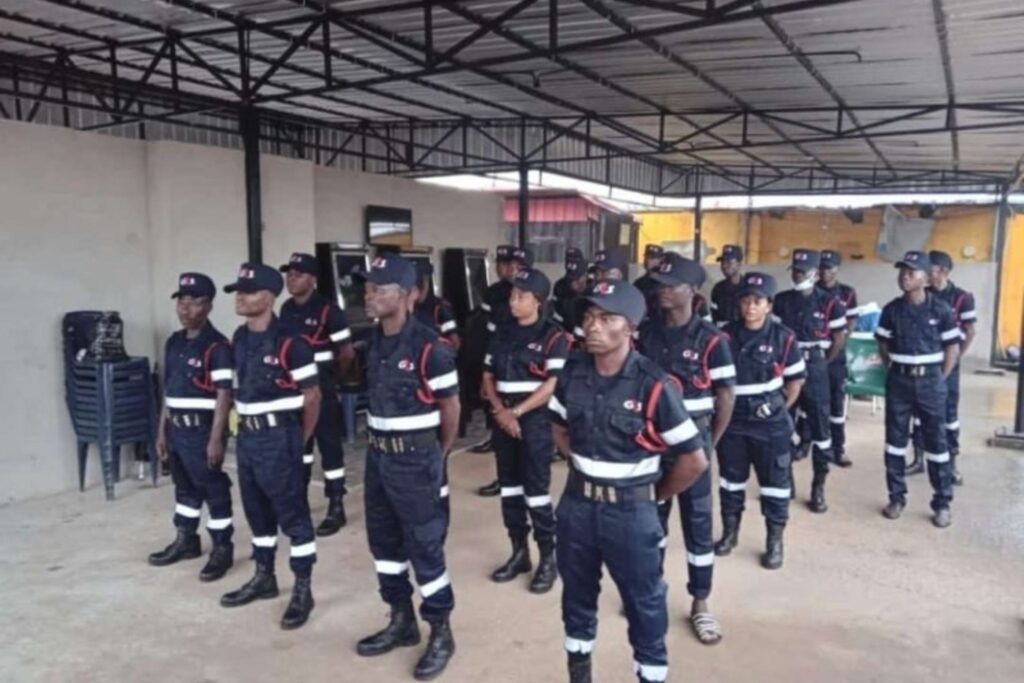
5. G4S NIGERIA
The Global Powerhouse: Unmatched Scale and Reach
Parent Company: Allied Universal (Global)
Year Founded: in Nigeria Late 1970s (40+ years)
Head Office: Lagos, Nigeria
Website g4s.com
Workforce: 5000 – 10,000 (Industry Estimate)
Specialisation: Manned guarding, cash solutions, secure logistics
Social Media: Strong professional LinkedIn presence
Background and Heritage
As a subsidiary of global security giant Allied Universal, G4S Nigeria brings unparalleled international resources and standards to the local market. Operating in Nigeria since the late 1970s—over four decades—G4S has witnessed and survived every phase of the nation’s political and economic evolution.
Scale and Manpower
G4S remains a dominant force based on sheer scale. Their manpower footprint, cash solutions network, and secure logistics infrastructure represent investments that would be difficult for any local competitor to replicate. While recent global restructuring has seen G4S divest from some markets, the Nigerian operation continues to leverage global best practices and quality standards.
Service Portfolio
- Manned Guarding: Trained personnel for static and mobile security
- Cash Solutions: Cash-in-transit, ATM servicing, and valuables logistics
- Secure Logistics: Transportation of high-value assets
- Electronic Security: Alarm monitoring and response
Social Media Presence
G4S maintains a strong professional presence on LinkedIn, frequently posting about industry standards, employee recognition, and technological upgrades. Their content strategy emphasises alignment with global best practices, reassuring multinational clients of consistent quality across jurisdictions.
Why Number Five?
G4S Nigeria claims the number five position because:
- Global Backing: Resources and standards of Allied Universal
- Unmatched Longevity: 40+ years of continuous Nigerian operation
- Scale: Manpower and infrastructure investments across multiple service lines
- Multinational Confidence: Preferred provider for international clients requiring global consistency
6. TRANSWORLD SECURITY SYSTEMS LTD

The Certification Pioneer: Bringing ASIS to West Africa
Founder: Dr. Ona Ekhomu (First Nigerian CPP)
CEO/MD: Dr. Victoria Ekhomu
Year Founded: 1980 (44+ years in operation)
Head Office: Lagos, Nigeria
Website: transworld.ng
Workforce: 500 – 2000 (Estimated)
Specialisation: Security equipment, systems integration, professional certification
Industry Recognition: 2026 OSPA Finalist
Background and Heritage
Established in 1980, Trans-World Security Systems is the foremost professional asset protection firm in the West African sub-region . With 44 years of continuous operation, Transworld brings experience that few competitors can match. The company’s approach is holistic: “from designing and supplying security equipment, to installation of security and safety systems” .
Pioneering Professional Certification
Transworld’s most significant contribution to the Nigerian security industry may be its role in professionalising the sector. The company’s founder, Dr. Ona Ekhomu, was the first Nigerian to attain the Certified Protection Professional (CPP) certification—the gold standard in global security management .
Building on this foundation, Transworld brought ASIS certification to West African shores, serving as the African Representative for the International Foundation for Protection Officers (IFPO) based in Naples, Florida. Through this role, Transworld facilitates:
- CPO (Certified Protection Officer) certification
- CSSM (Certified Security Supervisors & Management) certification
This commitment to international certification standards has elevated the entire Nigerian industry, creating pathways for security personnel to achieve globally recognised qualifications.
Industry Recognition
Transworld’s excellence continues to receive peer validation. The company has been shortlisted as a finalist in the 2026 Outstanding Security Performance Awards (OSPAs) in the highly competitive category of “Outstanding Contract Security Company” [citation:previous response]. This nomination—following a rigorous judging process—reflects sustained commitment to innovation and leadership.
Service Portfolio
Transworld’s comprehensive approach spans :
· Security Equipment: Design and supply of security hardware
· Systems Integration: Installation of security and safety systems
· Consultancy: Design and specification services for banks, oil firms, manufacturing companies, architects, engineers, and electrical contractors
Why Number Six?
Transworld Security Systems claims the number six position because:
- Pioneering Spirit: First to bring ASIS certification to West Africa
- Longevity: 44 years of continuous operation
- Industry Recognition: 2026 OSPA finalist nomination
- Founder’s Legacy: Dr. Ona Ekhomu’s CPP paved the way for Nigerian security professionals
- Holistic Approach: Integration of equipment, installation, and certification
7. TERRAHAPTIX
The Deep Tech Disruptor: Beating International Competition
Founders: Nathan Nwachukwu (CEO, 22) and Maxwell Maduka (CTO, 24)
CEO: Nathan Nwachukwu
Year Founded: 2023
Head Office: Abuja, Federal Capital Territory
Website: TerraIndustries.co
Workforce: 100 – 300 (Technical Staff)
Facility: 15,000 sq-ft drone factory, Abuja
Production Capacity: 5,000-10,000 units annually
Key Contracts: $1.2M hydroelectric plant security deal (2025)
Funding: $34M raised (2026) led by Lux Capital and 8VC
Social Media: LinkedIn followers, active innovation updates
Background: The Young Guns
Terrahaptix represents something new in Nigerian security: a deep-tech startup founded by entrepreneurs barely out of their teens, yet competing with—and beating—established international players. Founded in 2023 by Nathan Nwachukwu (22) and Maxwell Maduka (24), Terrahaptix has rapidly emerged as Africa’s most closely watched defence-technology startup .
Nathan Nwachukwu, the CEO, is a software engineer and industrialist who dropped out of university at 18 to solve Africa’s critical problems . Before Terrahaptix, he founded Klas, an edtech platform that now powers online schools for over 900,000 students globally, raising over $1.3 million from Techstars and Ingressive .
Maxwell Maduka, the CTO and Chief Engineer, brings deep technical expertise, having previously served as a lead drone engineer in the Nigerian Navy and founded Spatial Nova, a micro-drone company later acquired .
Manufacturing Capability
Terrahaptix operates a 15,000-square-foot robotics factory in Abuja’s Idu Industrial District—considered the largest drone manufacturing facility in Africa . The facility encompasses:
- Research and development lab
- 3D printing facility
- Machine shop
- Manufacturing line
- Annual production capacity: 5,000-10,000 units
Critically, Terrahaptix sources over 80% of components locally, enabling them to offer products at prices more than 50% lower than international competitors while maintaining quality .
The Artemis OS Advantage
Terrahaptix’s competitive edge lies in Artemis OS, a proprietary operating system that provides an integrated command-and-control platform across all their hardware . Artemis enables:
- Real-time monitoring and threat detection
- AI-powered classification of threats (including bandits, weaponry, and numerical strength)
- Coordinated command across aerial, ground, and fixed systems
- Cloud-based data storage and analysis
- Mission planning and autonomous response
This ecosystem approach—similar to Apple’s integrated hardware-software strategy—creates client lock-in through seamless user experience and ensures all components communicate flawlessly .
Product Suite
Terrahaptix’s integrated security ecosystem includes :
Archer UAV: A long-range VTOL surveillance drone with multispectral sensors, 3-hour flight time, and 200km range
Iroko First-Responder Drone: Autonomous rapid-response drone for critical infrastructure protection, introduced April 2025
Duma UGV: Unmanned ground vehicle for logistics, surveillance, and patrol, capable of pulling 2.5 tonnes
Kallon Sentry Tower: Solar-powered autonomous surveillance tower using AI to detect threats up to 5-20km away
Horizon Crop-Spraying Drone: Agricultural drone carrying 30 litres for large-scale farming operations
Landmark Contract Wins
$1.2 Million Hydroelectric Plant Deal (May 2025) : Terrahaptix beat an Israeli company to secure a five-year contract deploying AI-powered drones and sentry towers at two Nigerian hydroelectric power plants . The contract includes recurring six-figure annual software subscriptions, creating stable recurring revenue. The systems protect against bandits who had been using the plants as hideouts.
$500,000 Ghana Agricultural Contract (August 2024) : Supply of 70 Archer VTOL drones to GEMsolutions for large-scale agricultural operations in Ghana .
South African Mining Expansion (December 2024) : Exclusive distribution agreement with DiggingDeep to integrate Terrahaptix drones into mining operations across South Africa .
Funding and Valuation
In February 2026, Terrahaptix announced a $34 million funding round led by Silicon Valley venture firm Lux Capital and 8VC (founded by Joe Lonsdale, co-founder of Palantir Technologies) . Alex Moore, an 8VC partner and Palantir board member, joined Terrahaptix’s board. Enterprise value is estimated at $47-71 million.
Strategic Partnerships
DICON Joint Venture (February 2026) : Signed MOU with the Defence Industries Corporation of Nigeria for a joint venture focused on local production, assembly, R&D, and specialised training in drones, robotics, and cybersecurity .
Saudi Arabia Expansion (February 2026) : Agreement with Saudi industrial contractor AIC Steel to establish joint manufacturing facility in Saudi Arabia for infrastructure surveillance systems .
Why Number Seven?
Terrahaptix claims the number seven position because:
- Technological Breakthrough: Beating international competitors with locally developed AI systems
- Manufacturing Scale: Africa’s largest drone factory with 10,000-unit annual capacity
- Verifiable Contracts: $1.2M hydroelectric deal and expanding continental footprint
- Global Recognition: $34M funding from elite Silicon Valley venture firms
- Youth Leadership: Demonstrating that Nigerian entrepreneurs can build world-class deep tech
In an industry traditionally dominated by guard-force companies, Terrahaptix represents the future: technology-native, AI-powered, and globally competitive.
8. KINGS GUARDS NIGERIA LIMITED

The Corporate Blue-Chip Protector: Structured, Scalable, Institutional
Founder: Kingsley N. Nwoko (Founder/Chairman)
MD/CEO: Samuel Olaniran
Year Founded: 1992
Head Office: Lagos, Nigeria
Website: kingsguards.com
NSCDC: Licensed Private Guard Company
Workforce: 2000 – 4000 (Estimated)
Operational Footprint: Multi-state presence across Nigeria
Specialisation: Corporate guarding, financial institutions, oil & gas, FMCG, multinationals
Background and Heritage
Founded in 1992, Kings Guards Nigeria Limited has grown into one of the most recognisable indigenous security brands in the country. With over three decades of operational experience, the company has built its reputation serving Nigeria’s blue-chip corporate sector.
Unlike firms that built their brand on media visibility or policy advocacy, Kings Guards has focused on operational structure, guard discipline, and corporate client retention.
Longevity in Nigeria’s corporate security space — particularly across banking, oil & gas, telecommunications, and manufacturing — signals institutional resilience and structured management.
Regulatory Compliance and Corporate Standards
Kings Guards operates under full NSCDC licensing and is known within corporate circles for structured recruitment, vetting, and layered supervision protocols.
The company has developed a reputation for:
- Multi-tier supervision systems
- Centralised operations coordination
- Guard training academies
- Structured reporting frameworks
Their emphasis on corporate compliance makes them particularly attractive to regulated industries.
Operational Strength
Kings Guards’ primary strength lies in structured manpower at scale.
Their guard force deployment spans:
- Financial institutions
- Energy companies
- Telecommunications providers
- Manufacturing facilities
- High-end residential estates
The company’s ability to maintain operational consistency across multiple client categories places it firmly within Nigeria’s top-tier indigenous providers.
Technology Integration
While not positioned as a drone or AI-first company, Kings Guards integrates:
- CCTV deployment
- Access control systems
- Alarm monitoring
- Incident reporting digitisation
Their model represents the hybrid transition phase between traditional guarding and full digital ecosystems.
Why Number Eight?
Kings Guards claims the #8 position because:
- 30+ years of continuous operation
- Deep penetration of Nigeria’s corporate security market
- Structured guard-force management systems
- Strong indigenous brand recognition
- Multi-sector client retention
- Kings Guards represents the disciplined, institutional corporate security archetype.
9. OCEAN MARINE SOLUTIONS LIMITED
The Maritime Force Multiplier: Securing Nigeria’s Offshore Energy Corridor
Founder: Capt. Hosa Okunbo (Late)
MD/CEO: Ameen Idioka
Year Founded: 2007
Head Office: Port Harcourt, Nigeria
Website: www.ocean-ms.com
Workforce: 300 – 1000 (Estimated)
Operational Domain: Gulf of Guinea / Nigerian Offshore Waters
Specialisation: Maritime security, offshore asset protection, armed escort services
Background and Strategic Positioning
Ocean Marine Solutions Limited (OMS) occupies a unique and highly strategic position within Nigeria’s private security ecosystem. Founded in 2007 by the late Captain Hosa Okunbo, OMS emerged at a time when piracy in the Gulf of Guinea had reached alarming global levels.
Nigeria’s offshore oil platforms, FPSOs, and supply vessels had become prime targets for piracy and armed sea robbery. The economic implications were severe — not just for oil majors, but for national crude production and maritime insurance ratings.
OMS positioned itself as an indigenous maritime security specialist operating in partnership frameworks aligned with Nigerian naval authorities. Over nearly two decades, it has evolved into one of the most recognisable indigenous offshore security operators in West Africa.
Critical Infrastructure Protection: Offshore Energy Assets
Unlike traditional guard-force companies, OMS operates in the blue-water domain — an environment requiring:
- Armed escort vessels
- Naval coordination protocols
- Offshore logistics capability
- Marine surveillance operations
- High-risk response teams
Its core mandate involves securing:
- Offshore oil platforms
- Floating Production Storage and Offloading vessels (FPSOs)
- Oil & gas supply vessels
- Strategic marine transport corridors
In a country where petroleum accounts for a significant share of foreign exchange earnings, maritime asset protection is not peripheral — it is macroeconomically central.
National and International Impact
Nigeria’s anti-piracy progress over the past decade — including improved Gulf of Guinea security ratings — reflects coordinated federal, naval, and private sector efforts. OMS has operated within this ecosystem, contributing to the stabilisation of offshore operational environments.
By operating within government-sanctioned maritime security frameworks, OMS demonstrates a level of institutional trust that few private firms achieve.
Its operational domain is internationally visible — maritime security directly affects:
- Global shipping routes
- International oil markets
- Marine insurance premiums
- Nigeria’s sovereign risk profile
This elevates OMS beyond domestic guarding into geopolitically relevant security operations.
Indigenous Advantage in Maritime Security
Maritime security in Nigerian waters requires more than vessels and personnel. It requires:
- Local intelligence networks
- Terrain familiarity
- Community engagement in coastal regions
- Coordination with regulatory authorities
- Operational adaptability in complex riverine environments
As an indigenous firm, OMS combines local insight with structured operational protocols — a balance international contractors often struggle to achieve.
Technology and Operational Model
While not positioned as a drone manufacturer like Terrahaptix or a VTOL adopter like Tantita, OMS integrates:
- Marine patrol vessels
- Escort craft
- Surveillance equipment
- Structured communication systems
- Coordinated naval engagement frameworks
Its model is operational-technology integrated rather than hardware-manufacturing focused.
Why Number Nine?
Ocean Marine Solutions claims the number nine position because:
- Specialised maritime security leadership in the Gulf of Guinea
- Direct protection of offshore oil & gas assets
- Nearly two decades of continuous operation
- Government-aligned maritime security frameworks
- Contribution to improved offshore security stability
OMS introduces a crucial vertical to this ranking: blue-water and offshore infrastructure security.
10. BEMIL NIGERIA LIMITED

The Silent Endurance Champion: 48 Years of Unbroken Service
Founder: Olajide Martins
CEO/MD: Olajide Martins (Jnr)
Year Founded: 1978 (48 years in operation)
Head Office Berger, Lagos with offices in Abuja and Asaba
Website bemilnigeria.com
Workforce 1,001-5,000 employees
Service Portfolio Manned Guarding, Cash-in-Transit, K9 Services, Concierge Services, Electronic Security, Journey Management, Security Consultancy & Training
LinkedIn Active presence with 1,001-5,000 employees
Background and Heritage
Bemil Nigeria Limited occupies a unique position in Nigeria’s private security landscape: it is among the oldest continuously operating indigenous security companies in the nation. Founded in 1978—48 years ago—Bemil has witnessed and survived every phase of Nigeria’s political and economic evolution.
While many competitors have come and gone, Bemil has maintained an unbroken presence, building relationships across generations of clients and security personnel. This longevity is itself a credential—one that speaks to institutional stability, client trust, and the ability to adapt across vastly different security environments.
Operational Footprint
Bemil maintains active operations across Nigeria’s key economic corridors:
- Lagos (Berger): Headquarters and major operational base
- Abuja (Wuse Zone 4): Federal Capital Territory presence
- Asaba, Delta State: South-South operational footprint
Recent recruitment drives (January-February 2026) for Escort Drivers, HR Operations, Sales professionals, and Crew Drivers indicate ongoing operational vitality and client demand.
Service Portfolio
Bemil’s comprehensive service offerings span the full spectrum of traditional and specialized security:
- Manned Guarding: Static and mobile security personnel
- Cash-in-Transit: Valuable protection and secure logistics
- K9 Services: Trained canine units for detection and patrol
- Concierge Services: Reception and front-of-house security
- Electronic Security: Surveillance and access control systems
- Journey Management: Fleet security and executive protection
- Security Consultancy & Training: Advisory services and capacity building
This diversified portfolio allows Bemil to serve clients across banking, oil and gas, manufacturing, and government sectors—though specific client names are not publicly disclosed.
Assessment: Strengths and Limitations
Strengths:
- Exceptional Longevity: 48 years of continuous operation—a record few can match
- Established Scale: Workforce of 1,001-5,000 employees
- Geographic Reach: Presence in Lagos, Abuja, and Delta State
- Operational Consistency: Active recruitment demonstrating ongoing client demand
- Comprehensive Services: Full-spectrum security capabilities
Areas for Development:
- Industry Recognition: No visible OSPA nominations or third-party awards
- Technology Narrative: Limited public information on electronic security deployments
- Policy Voice: Leadership not publicly engaged in industry advocacy
- Recent Headlines: No major contract announcements comparable to competitors
Why Number Ten?
Bemil Nigeria Limited claims the tenth position not because it matches the technological sophistication of Terrahaptix or the awards haul of Halogen, but because 48 years of uninterrupted operation in Nigeria’s challenging business environment is itself a form of excellence.
In an industry where trust is the ultimate currency, Bemil has earned it the old-fashioned way: by showing up, day after day, for nearly five decades. The company represents the “silent endurance” category of Nigerian private security—operators who may not generate headlines but provide reliable service to clients who value stability above flash.
A Note to Readers
Bemil’s inclusion reflects our commitment to honoring different dimensions of excellence. While other companies on this list lead in technology (Terrahaptix, Tantita), policy influence (Proton), or awards (Halogen, Transworld), Bemil leads in longevity and steady endurance. For clients seeking a partner with demonstrated staying power across five decades, Bemil offers something invaluable: proof of survival.
METHODOLOGICAL NOTES AND ACKNOWLEDGEMENTS
2026 COMPARATIVE SCORING TABLE
| Company | Reg (10) | Longevity (10) | Tech (20) | Awards (15) | Infrastructure (20) | Policy (10) | Thought Leadership (5) | Scale (10) | Total |
|---|---|---|---|---|---|---|---|---|---|
| Sheriff Deputies | 10 | 9 | 17 | 12 | 15 | 9 | 5 | 9 | 86 |
| Halogen | 10 | 10 | 16 | 15 | 14 | 7 | 4 | 9 | 85 |
| Proton | 10 | 9 | 14 | 6 | 15 | 10 | 5 | 10 | 79 |
| Tantita | 9 | 6 | 18 | 5 | 20 | 6 | 3 | 8 | 75 |
| G4S Nigeria | 10 | 10 | 14 | 10 | 15 | 6 | 4 | 10 | 79 |
| Transworld | 10 | 10 | 13 | 12 | 12 | 6 | 3 | 8 | 74 |
| Terrahaptix | 8 | 4 | 20 | 8 | 16 | 6 | 4 | 7 | 73 |
| Kings Guards | 10 | 10 | 12 | 5 | 13 | 5 | 3 | 9 | 67 |
| Ocean Marine Solutions | 10 | 8 | 14 | 6 | 18 | 6 | 3 | 8 | 73 |
| Bemil | 10 | 10 | 10 | 3 | 12 | 3 | 2 | 8 | 58 |
Data Sources
This report synthesises information from multiple publicly available sources, including:
- Company websites and official publications
- LinkedIn company pages and executive profiles
- Industry awards programs (OSPAs)
- Business media coverage (BusinessDay, Nairametrics, naijapreneur, Vanguard, Punch)
- Regulatory disclosures and certifications
- Published interviews and thought leadership content
Limitations
The private nature of security companies means certain data points—particularly financial performance, exact workforce numbers, and detailed client lists—are not publicly available. Where official data was unavailable, we relied on media reports, industry recognition, and verifiable contract announcements.
Transparency Note on Bemil Nigeria Limited
Bemil’s inclusion at number ten reflects a deliberate methodological choice to honor longevity and operational consistency as distinct forms of excellence. While the company lacks the recent awards, technology headlines, or policy visibility of other ranked firms, its 48-year unbroken track record represents a different but equally valid dimension of industry leadership. Readers are encouraged to evaluate all companies against their specific needs—whether those prioritize cutting-edge technology, policy influence, or proven staying power.
Updates and Corrections
The security industry evolves rapidly. This list reflects the landscape as of March 2026. Companies that demonstrate significant new capabilities, contracts, or industry recognition may feature in future editions.
CONCLUSION: THE FUTURE OF NIGERIAN PRIVATE SECURITY
As this list demonstrates, Nigerian private security is no longer merely about guards at gates. The industry has evolved into a sophisticated ecosystem encompassing:
- Traditional manned guarding at scale (Kings Guards, G4S, Proton, Sheriff Deputies, Bemil)
- Technology-enabled surveillance (Tantita, Terrahaptix)
- Professional certification and standards (Transworld)
- Policy advocacy and legislative influence (Proton)
- Specialised niche expertise (Ocean Marine Solutions in Maritime Security)
- Integrated manpower-technology solutions (Halogen, Sheriff Deputies)
Three trends will shape the industry’s future:
First, technology will continue to displace pure manpower solutions. Companies that cannot demonstrate AI integration, drone capabilities, or intelligent surveillance will struggle to compete for premium contracts. Terrahaptix’s $34 million funding round and Tantita’s Textron partnership signal where the market is heading.
Second, policy influence will become a competitive differentiator. As the government withdraws police from private duties and considers armed guard regulations, companies that shape these conversations—like Proton’s Adekunmi Odebunmi—will enjoy first-mover advantages.
Third, longevity retains value. Bemil’s 48-year track record reminds us that stability and trust remain foundational. Not every client needs cutting-edge drones; many need partners who will simply be there, decade after decade.
Sheriff Deputies Ltd’s number one ranking reflects a company that understands all three trends. By combining 25 years of operational heritage with aggressive digital transformation and national CSR consciousness, they exemplify the industry’s past, present, and future.
The Nigerian private security industry is entering its most dynamic period yet. These ten companies represent the best of what the sector offers today—and a glimpse of where it is heading tomorrow.
Source: naijapreneur.com